Guides explaining the billing logic and verification costs:
- Understanding KYC Verification Costs in Client Relay
- Billing Mechanics for Submissions
- Charge Statuses and Reconciliation
- Handling Duplicate and Retried Attempts
Understanding KYC Verification Costs in Client Relay
When your clients complete their AUSTRAC-required KYC/AML verifications through Client Relay, the process involves three distinct background checks. Each of these services is billed independently per genuine verification submission. For additional regulatory background on these procedures, please refer to the file kyc aml.pdf.
- eKYC: Electronic identity matching against independent data sources under AUSTRAC's Safe Harbour 2+2 procedure.
- DVS: Australian Government Document Verification.
- PEP & Sanctions: Screening against politically exposed person and sanctions lists.
Billing Mechanics for Submissions
A charge is generated for every genuine verification attempt, regardless of whether the individual ultimately passes or fails the check. Currently, there is no system cap on the number of billable attempts an individual can make within the API.
If an individual successfully passes the initial stages, a complete verification will incur a single charge across all three services. If an individual fails at the DVS stage, the PEP & Sanctions screening is not triggered. This sequence explains why a failed attempt might only result in charges for eKYC and DVS.
Charge Statuses and Reconciliation
To ensure accurate billing and reporting within Client Relay, it is crucial to understand which charge statuses map to actual costs:
- Valid Charges: Statuses marked as SUCCEEDED (captured), PENDING, or PENDING_CAPTURE represent valid, billable charges.
- Invalid Charges: Statuses marked as FAILED or VOIDED are not valid billable charges.
- Record Keeping: VOIDED rows retain their original amount on record for reconciliation purposes but must be excluded from any total billing calculations.
Handling Duplicate and Retried Attempts
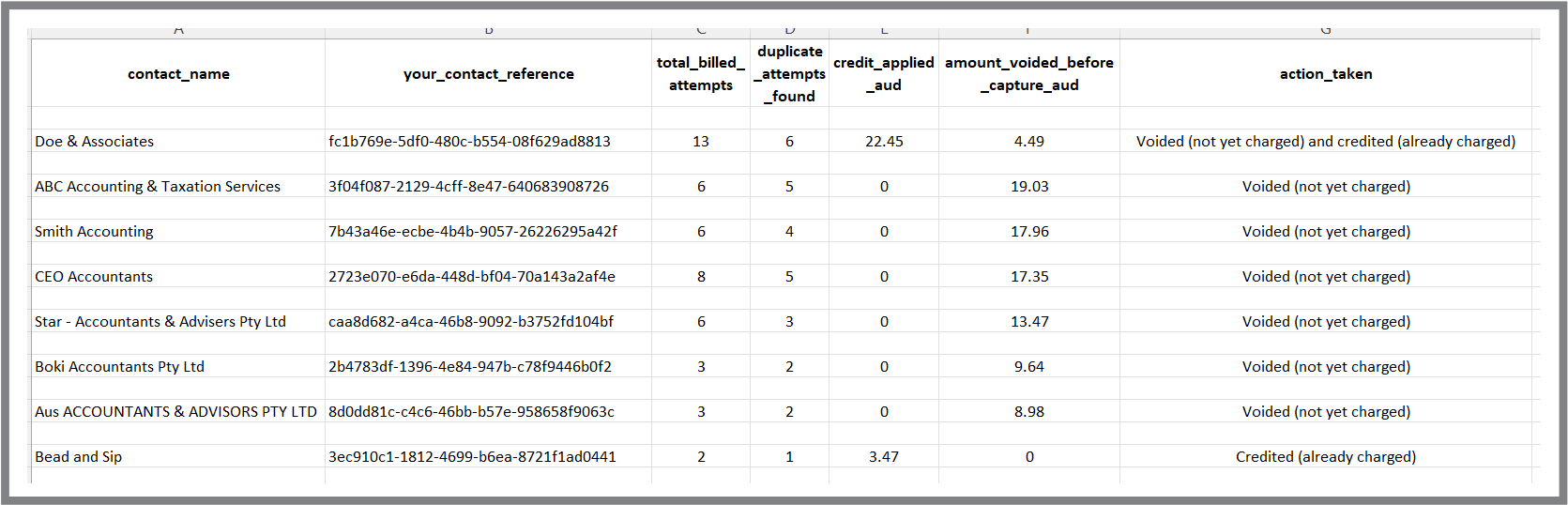
Occasionally, a verification provider may retry a check internally after an error. The API handles these internal retries by treating them as a single submission rather than generating duplicate charges. If duplicate charges were previously generated from an internal retry, these statuses are updated to VOIDED, and any amounts already billed are credited back to the account.
Was this article helpful?
That’s Great!
Thank you for your feedback
Sorry! We couldn't be helpful
Thank you for your feedback
Feedback sent
We appreciate your effort and will try to fix the article